
EU AI Act Guide for Businesses: How to Prepare for Compliance
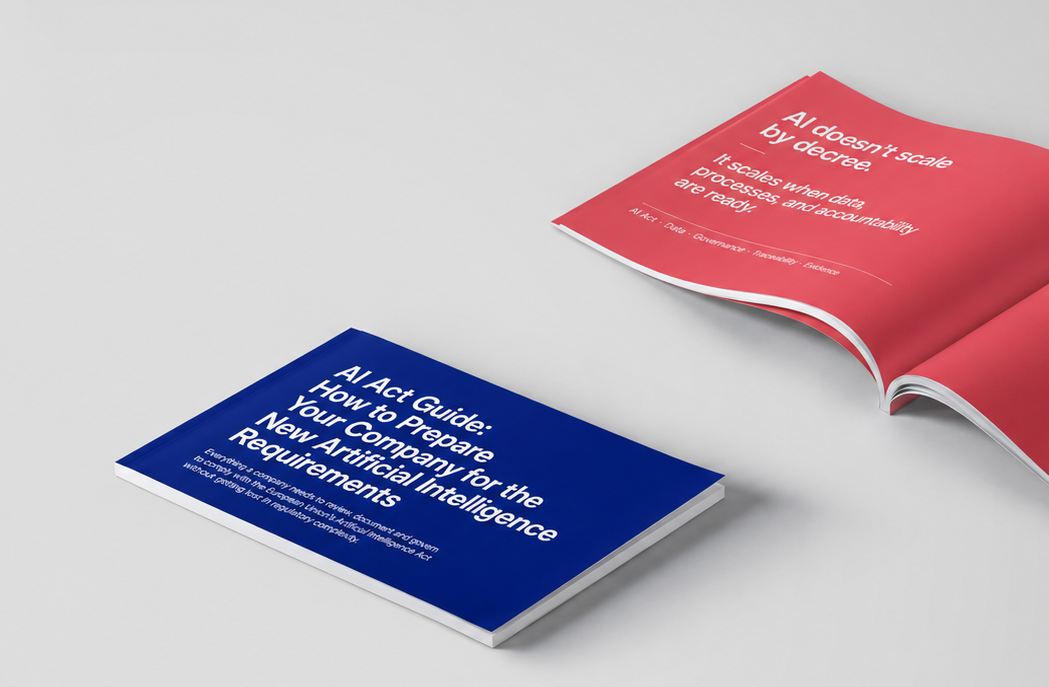
▶️ The EU AI Act is no longer a future conversation.
Starting August 2, 2026, companies need to use AI with transparency, AI literacy, prohibited practices, general-purpose models, and internal evidence will all require real preparation.
EU AI Act compliance is now a business readiness challenge
The EU AI Act is no longer a future concern. It is already changing how organizations are expected to use, document and govern artificial intelligence.
For many companies, the challenge is not only legal. It is operational. AI is already embedded in copilots, chatbots, SaaS platforms, automation workflows, analytics tools, third-party models, APIs, internal assistants and enterprise applications. But in many cases, organizations still lack a clear view of where AI is being used, what data it relies on, which providers are involved and who is responsible for its oversight.
That is where AI Act readiness begins.
EU AI Act compliance starts with visibility: knowing which AI systems your organization uses, what they do, what data feeds them, who supervises them and what evidence can be provided if needed.
Without that visibility, companies may struggle to classify risk, apply transparency measures, review providers, document controls or demonstrate that AI is being used responsibly.
The risk is not only for companies that sell AI, but also for companies who use AI
A company does not need to build its own AI models to be affected by the EU AI Act. Many organizations may be impacted simply because they deploy, integrate or use AI systems in business processes.
This includes AI used in customer service, marketing, HR, finance, operations, cybersecurity, analytics, internal productivity, decision support or automated workflows.
For this reason, AI Act preparation should not sit only with legal or technical teams. It requires coordination between business, data, IT, cybersecurity, procurement, compliance, risk and innovation teams.
A practical AI Act readiness process should help the organization answer six core questions:
- Which AI systems are currently being used?
- What business processes do they support?
- What data feeds each system?
- Which providers, models or platforms are involved?
- Who approves, monitors and owns each use case?
- What risks, controls and evidence exist?
Why waiting creates unnecessary risk
The EU AI Act introduces obligations progressively, but companies should not wait until every deadline is close. AI governance, data traceability, provider review and internal evidence cannot be built in a few weeks.
Companies that prepare too late often discover that the real gap is not a missing policy. It is a missing governance system.
They lack an AI inventory, risk criteria, ownership model, data controls, contractual review, transparency processes, training records and documented evidence.
AI Act readiness is not a last-minute compliance exercise. It is the process of building the visibility, governance, data foundations and evidence needed to use AI with confidence.
This guide helps organizations move from regulatory uncertainty to a practical roadmap for AI governance and compliance readiness.
What you will find in this EU AI Act guide for businesses
This EU AI Act guide for businesses summarizes the key areas organizations should review to prepare for the new AI regulatory requirements.
It is not designed as a legal manual. It is a visual, practical guide to help companies understand what needs to be reviewed, aligned and documented before AI compliance becomes a last-minute problem.
Key EU AI Act dates and milestones
The guide explains the main application dates of the EU AI Act and what they mean for companies.
It helps organizations understand which obligations are already relevant, which requirements are becoming more concrete and which milestones should be prepared in advance.
Roles and responsibilities under the EU AI Act
The EU AI Act does not affect every company in the same way. Responsibilities depend on the role an organization plays in each AI system.
A company may act as a provider, deployer, importer, distributor or user of general-purpose AI systems depending on the use case, the tool, the provider relationship and the way AI is integrated into business processes.
This guide helps clarify why roles must be assessed case by case.
AI risk classification
The EU AI Act follows a risk-based approach. The guide provides a practical overview of prohibited AI practices, high-risk AI systems, transparency obligations, general-purpose AI models and lower-risk uses.
The focus is not only on classifying the technology, but on understanding how each AI system is used in a real business context.
A 10-point AI Act readiness checklist
The guide includes a practical checklist to help companies review the most important dimensions of AI Act preparation:
- AI inventory
- Roles and responsibilities
- Risk classification
- Prohibited practices
- AI literacy
- Transparency
- AI-generated content
- Internal AI governance
- Data, security and compliance
- Providers and contracts
This checklist helps translate complex regulation into actionable questions for executive, data, technology, legal, compliance and innovation teams.
Data, security, providers and contracts
AI compliance depends heavily on the foundations behind each system.
That is why the guide also covers data quality, access controls, lineage, metadata, traceability, cybersecurity, provider review and contract governance.
It also highlights the need to review software, cloud, SaaS, API, model, copilot and AI-enabled tool agreements to understand how responsibilities are distributed between the company and its providers.
A practical framework for AI governance
The guide proposes a structured approach to AI Act readiness:
inventory, classify, govern, document and monitor.
This framework helps organizations move beyond isolated compliance actions and start building a more sustainable model for AI governance, traceability and evidence.
Preparing for the EU AI Act means creating an AI governance system capable of showing what AI is used, who controls it, what data it relies on and what evidence exists.
Who is this EU AI Act guide for?
This guide is designed for organizations that already use artificial intelligence or are starting to integrate AI capabilities into their processes, platforms, products or services.
It is especially useful for companies that want to understand how the EU AI Act may affect their AI strategy, data governance, technology architecture, provider management and internal compliance processes.
Executive teams and transformation committees
For leadership teams, the EU AI Act raises a strategic question: how can the organization scale AI without increasing regulatory, operational or reputational exposure?
The guide helps position AI compliance as part of the broader transformation, governance and risk agenda.
Data, analytics and AI leaders
Data and AI teams will find a practical view of what needs to be governed and documented: AI systems, use cases, data quality, lineage, traceability, models, human oversight and evidence.
IT, cybersecurity and architecture teams
For IT and security teams, the guide connects the EU AI Act with operational issues such as access management, system integration, cloud platforms, cybersecurity, monitoring, APIs, SaaS tools and technical controls.
Legal, compliance and risk teams
Legal and compliance teams can use the guide to coordinate with business, data and technology teams.
AI Act compliance is not only about interpreting regulation. It also requires technical evidence, internal processes, assigned responsibilities and up-to-date documentation.
Innovation, automation and process leaders
Teams working with automation, copilots, agents or generative AI can use the guide to evaluate AI use cases before scaling them.
It helps identify the questions that should be answered before an AI system is deployed, integrated into a critical process or exposed to employees, customers or users.
Companies using generative AI, copilots, chatbots or AI-enabled tools
The guide is especially relevant for organizations already using generative AI tools, copilots, conversational assistants, agents, intelligent automation or enterprise software with embedded AI capabilities.
In these cases, the risk often comes from lack of visibility: AI adoption spreads across the organization faster than governance.
Preparing for the EU AI Act also means preparing AI to work better
The EU AI Act should not be approached only as a regulatory obligation. For many companies, it can become a useful framework to organize what enterprise AI needs in order to scale: reliable data, clear responsibilities, governance, security, traceability and evidence.
AI does not work well in opaque environments.
When data is fragmented, access is uncontrolled, providers are not properly reviewed, usage criteria are unclear and responsibilities are undefined, AI becomes harder to trust, explain, monitor and scale.
AI does not become reliable only because the model is more advanced. It becomes reliable when it operates on governed data, clear processes, assigned responsibilities and demonstrable evidence.
From reactive compliance to AI governance
Many companies start by asking what the regulation requires. That question matters, but it is not enough.
The deeper question is whether the organization can demonstrate how it uses AI.
That requires a structural approach: identifying AI systems, classifying risk, reviewing providers, training teams, documenting evidence and creating a governance model that can evolve as AI adoption grows.
Why data is the starting point
AI compliance starts before the model. It starts with data.
Organizations need to know what data feeds each AI system, where it comes from, what quality standards apply, who can access it, what processing takes place, what traceability exists and what security controls protect it.
Without that foundation, any AI initiative becomes harder to explain, audit, govern and scale.
An opportunity to bring order to enterprise AI
The EU AI Act can be seen as a regulatory challenge, but also as an opportunity to bring order to AI adoption.
Companies that build strong foundations in data governance, integration, security and AI oversight will be better prepared not only to comply, but to deploy artificial intelligence with greater confidence, control and business impact.
Access the free EU AI Act guide for businesses
▶️ At Bismart, we help companies assess their AI readiness across data, infrastructure, governance and processes so they can deploy AI with greater control, traceability and confidence.
Frequently Asked Questions About the EU AI Act for Businesses
What is the EU AI Act?
The EU AI Act is the European Union’s regulatory framework for artificial intelligence. It sets rules for the development, deployment and use of AI systems, with obligations that vary depending on the level of risk associated with each system.
For businesses, the EU AI Act means that artificial intelligence can no longer be treated only as a technology or productivity tool. AI becomes a capability that must be understood, documented, supervised and governed.
The regulation is built around a risk-based approach, covering areas such as prohibited AI practices, high-risk AI systems, transparency obligations, general-purpose AI models, AI literacy and governance. Its purpose is to promote trustworthy AI while protecting safety, fundamental rights and transparency across the European market. The EU AI Act applies progressively, with key milestones between August 2024 and August 2028.
When does the EU AI Act apply?
The EU AI Act entered into force on 1 August 2024, but its obligations apply progressively. General provisions, including AI literacy, and prohibited AI practices started to apply on 2 February 2025. Rules for general-purpose AI models started to apply on 2 August 2025. On 2 August 2026, most AI Act rules started to apply, including transparency obligations under Article 50 and enforcement for applicable rules on general-purpose AI models, prohibitions, transparency and AI literacy.
For companies, this means AI Act compliance should not be treated as a single deadline. Different obligations apply at different stages, and some requirements may need significant preparation. AI inventories, role mapping, provider review, data governance, transparency measures and internal evidence are difficult to build at the last minute.
Which companies are affected by the EU AI Act?
The EU AI Act can affect companies that develop, provide, deploy, import, distribute or use AI systems in the European Union. It is not only relevant for companies that build AI models. Organizations may also be affected when they use third-party AI tools, SaaS platforms, copilots, chatbots, APIs, agents, analytics solutions or enterprise applications with embedded AI.
The key question is not simply whether a company develops AI. The key question is what role the company plays in each AI use case.
A business may act as a provider in one context and as a deployer in another. It may also rely on general-purpose AI models supplied by third parties. That is why EU AI Act readiness requires a case-by-case assessment of systems, data, providers, responsibilities and risks.
What EU AI Act requirements should companies review?
Companies should review the EU AI Act requirements that may apply to their AI systems, use cases and organizational role. At a minimum, businesses should assess prohibited AI practices, AI literacy, transparency obligations, general-purpose AI model dependencies, high-risk AI classification, provider and deployer responsibilities, data governance, human oversight, cybersecurity, documentation and record-keeping.
For high-risk AI systems, the AI Act includes requirements related to risk management, data quality and governance, technical documentation, record-keeping, transparency, human oversight, accuracy, robustness and cybersecurity.
For many organizations, the practical starting point is simpler: identify which AI systems are being used, classify their level of risk, define who owns each use case, review vendors and document the evidence needed to demonstrate responsible AI governance.
How can companies prepare for the EU AI Act?
Companies can prepare for the EU AI Act by building a structured AI governance and compliance readiness process. The first step is to create an inventory of AI systems, including copilots, chatbots, agents, SaaS tools, third-party models, APIs, automation workflows and internal AI solutions.
Once the inventory is in place, companies should identify their role in each use case, classify AI systems by risk, review prohibited practices, assess transparency obligations, define responsible owners, document data sources, evaluate providers and establish evidence for internal controls.
Preparation should involve legal, compliance, data, IT, cybersecurity, procurement, business and innovation teams. AI Act readiness is not only a legal review. It is an enterprise governance process designed to show what AI is being used, how it works, what data it relies on, who supervises it and what evidence exists.
Preparing for the AI Act means being able to demonstrate what AI the organization uses, who controls it, what data feeds it, what risks it entails, and what evidence exists to justify its use.
How is the EU AI Act connected to data governance?
The EU AI Act is closely connected to data governance because AI systems depend on the quality, relevance, traceability, security and control of the data they use. In high-risk AI systems, the regulation refers to data governance and management practices for training, validation and testing datasets, as well as requirements related to technical documentation, record-keeping, transparency, human oversight, accuracy, robustness and cybersecurity.
For companies, this means AI compliance cannot be separated from the data foundation. If an organization does not know what data feeds each AI system, where the data comes from, who can access it, how quality is controlled or what lineage exists, it will struggle to explain, monitor and govern AI effectively.
In practice, preparing for the EU AI Act also means strengthening data governance, access controls, metadata, lineage, security and evidence management.
Does the EU AI Act apply to generative AI tools, copilots, chatbots and agents?
Yes. The EU AI Act can apply to generative AI tools, copilots, chatbots, conversational agents and AI systems that generate or manipulate content. The exact obligations depend on the system, the use case, the organization’s role and the level of risk involved.
Transparency is especially important for interactive and generative AI systems. Article 50 of the AI Act applies from 2 August 2026 and sets transparency obligations for providers and deployers of certain AI systems, including generative and interactive AI systems and deepfakes. Providers must design AI systems so that people are informed when they are directly interacting with AI, and they must add machine-readable marks to enable detection of AI-generated or manipulated content. Deployers must also inform individuals in specific cases, such as deepfakes, emotion recognition or biometric categorisation tools.
Why is an AI system inventory important for EU AI Act readiness?
An AI system inventory is one of the most important starting points for EU AI Act readiness because a company cannot govern AI it has not identified. The inventory gives the organization visibility over where AI is being used, what each system does, which business process it supports, what data it uses, which provider is involved and who is responsible for oversight.
A useful AI inventory should include internal AI tools, third-party AI systems, SaaS platforms with embedded AI, copilots, chatbots, agents, models, APIs and automation workflows. It should also capture the purpose of each system, the business owner, the users affected, the data involved, the level of autonomy, provider information and an initial risk classification.
Without an AI inventory, companies may find it difficult to assess roles, classify risks, apply transparency measures, review providers or demonstrate evidence of AI governance.
A company cannot govern AI that it has not identified. The inventory transforms the scattered use of AI into a visible, classifiable, and manageable foundation.
What evidence should companies keep to demonstrate EU AI Act readiness?
Companies should keep evidence that shows how they identify, assess, govern and monitor AI systems. For EU AI Act readiness, useful evidence may include an AI system inventory, risk classification records, role assessments, provider reviews, contractual documentation, data maps, access controls, transparency notices, AI literacy records, internal policies, approval workflows, human oversight measures, incident logs and monitoring records.
For high-risk AI systems, the AI Act refers to requirements such as technical documentation, record-keeping, transparency information for deployers, human oversight, accuracy, robustness and cybersecurity.
For most organizations, the principle is clear: AI governance must be demonstrable. It is not enough to say that AI is controlled. The company should be able to show what was assessed, who approved it, what controls exist, what data is used and how the system is monitored over time.
What are the transparency requirements under the EU AI Act?
The EU AI Act transparency requirements are designed to help people understand when they are interacting with AI or exposed to AI-generated or manipulated content. Article 50 applies from 2 August 2026 and covers certain AI systems, including generative AI, interactive AI systems and deepfakes.
In practical terms, providers must design AI systems so that individuals are explicitly informed when they interact directly with AI. Providers must also add machine-readable marks to enable detection of AI-generated or manipulated content. Deployers must inform individuals when they are exposed to emotion recognition tools, biometric categorisation systems, deepfakes or certain AI-generated text on matters of public interest without human review or editorial control.
For companies, transparency requires more than a generic disclaimer. It may involve reviewing chatbots, virtual assistants, AI-generated content, publication workflows, user notices, labelling practices and evidence that disclosure measures are actually in place.